Amidst the usual fanfare and hype surrounding any Apple product launch, the iPhone seems destined to be the next star product from the company. Described by Steve Jobs as "magical" and "revolutionary", the iPhone is expected to change the landscape of technology once again.
But before we start drooling over it, a bit of reality wouldn't do any harm. The iPhone is a combination of the legendary iPod and a GSM phone. It also comes loaded with standard smartphone features, Bluetooth and PIM functionalities. The one thing that is sure to excite Apple loyals is the operating system it runs : OS X. Put in a sleek Apple-style cool interface and you have got the iPhone. The 4 GB model that would be released later this year comes at $499, and a 8 GB one would cost $599.
The iPhone has no usable feature that isn't available on other competing devices, so I can't see why they would call it magical and revolutionary. If you are talking about the capability to play MP3 and other digital audio formats on mobile phones, others have had it for years together. WiFi and Bluetooth are nothing new either.
Apple has, quite predictably, decided not to open up the iPhone to third party applications. Any new application that you would like to run on the iPhone would have to come from Apple, and that too, at a price. Most mobile platforms, including Symbian and Microsoft, allow third party software to be run on their systems. This encourages more developers to contribute software, which in turn attracts more users looking for greater variety of software. (Also known as the Network effect).As a result, the price of software on these platforms would be much lower than controlled platforms like Apple's, simply because of the demand supply equations.
iPhone applications would be costlier to develop as developers would have to pay out huge sums as royalties and license fees to Apple, and this would inflate cost to the end user. So anybody getting an iPhone is not only looking at the base price tag, but a much higher investment in terms of cost of additional software. The usual service charges associated with Apple would still stick, as even the battery comes built-in and you would have to go to Apple for servicing it.
With all the above, Apple doesn't seem to be looking to market the iPhone to the masses. But then again, Apple has never tried to be the mass-market company. Either way, it would be really interesting to see how the iPhone does in the already crowded market.
BBC, Wikipedia (Technical specifications)
Jan 13, 2007

Dec 30, 2006
Neuronet - The Matrix is here?
The Matrix films have been ridiculed by many people to be an impossible scenario- with machines enslaving human beings and feeding off our body heat to keep us immersed in a virtual world. Well, they have not mastered us yet, but a recent announcement from the International Association of Virtual Reality Technologies could indicate the birth of a more Matrix-like Internet.
Called the Neuronet, scheduled to go live in 2007, the network would provide a platform for virtual reality and gaming innovators around the world to develop applications for a second-generation network.
Virtual reality refers to computing systems which provide sensory feedback to the user to make her feel like she is actually in a different environment. For example, flight simulators are examples of virtual reality environments where a trainee pilot can learn the nuances of flight training before actually flying a multi-mllion dollary aircraft.
Although much cruder than the versions depcited in sci-fi movies like the Matrix, virtual reality is all set to grow in the coming years with quantum improvements in computing power and network bandwidth.
The Neuronet would be separate from the current Internet, the IAVRT announcement explains. Virtual reality programs like IBM's Second Life has become very popular among its members, where they can actually live out a virtual life.
3D designer Sven Johnson has questioned the "reality" of the virtual reality network, saying that it could be a "get-rich-quick" scam funded by domain name sales. (link)
Scam or not, it is only a matter of time before virtual reality environments become more possible and inviting to the masses. Even now, the chore of getting online, checking your mail and IMs, hanging around in a social networking site, etc. is considered by some to be "virtual reality". Where "real" ends and "virtual" begins is becoming a tougher question to answer.
CNET article
Called the Neuronet, scheduled to go live in 2007, the network would provide a platform for virtual reality and gaming innovators around the world to develop applications for a second-generation network.
Virtual reality refers to computing systems which provide sensory feedback to the user to make her feel like she is actually in a different environment. For example, flight simulators are examples of virtual reality environments where a trainee pilot can learn the nuances of flight training before actually flying a multi-mllion dollary aircraft.
Although much cruder than the versions depcited in sci-fi movies like the Matrix, virtual reality is all set to grow in the coming years with quantum improvements in computing power and network bandwidth.
The Neuronet would be separate from the current Internet, the IAVRT announcement explains. Virtual reality programs like IBM's Second Life has become very popular among its members, where they can actually live out a virtual life.
3D designer Sven Johnson has questioned the "reality" of the virtual reality network, saying that it could be a "get-rich-quick" scam funded by domain name sales. (link)
Scam or not, it is only a matter of time before virtual reality environments become more possible and inviting to the masses. Even now, the chore of getting online, checking your mail and IMs, hanging around in a social networking site, etc. is considered by some to be "virtual reality". Where "real" ends and "virtual" begins is becoming a tougher question to answer.
CNET article
Dec 2, 2006
Opera Mini 3 - Mobile web unleashed
Study after study proclaims the arrival of the Mobile Web, information on the go and being "always connected". The few who have actually explored the Web on our mobile devices would know better that things are not all that great right now. Clumsy browsers trying hard to fit Web pages on the small screen, slow download speeds and the worst of all, the exorbitant charges for data usage by mobile operators.
Opera Mini 3
Opera Software, the makers of the popular desktop Web browser, have announced the latest version of their browser for Mobile phones, Opera Mini 3. Opera Mini is a Java application that can be installed on most of today's smartphones or mobile devices supporting Java.
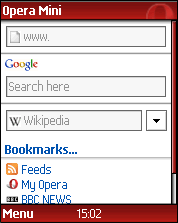 Unlike traditional mobile browsers like Opera's own Opera Mobile and Symbian browser, the Mini does not connect to the concerned web server directly. Instead, it connects to a proxy server that fetches the requested page and reformats the original HTML, Javascript and multimedia content into a format optimised for mobile phones. Thus, when you type www.yahoo.com in the address bar, the application relays it to the proxy. The proxy then fetches the Yahoo! homepage, strips it off all the bells and whistles, optimises for your specific device and sends it to the application. All the app has to do is take this and render on the screen, a much easier task when the heavy objects are taken off.
Opera Mini 3
Opera Software, the makers of the popular desktop Web browser, have announced the latest version of their browser for Mobile phones, Opera Mini 3. Opera Mini is a Java application that can be installed on most of today's smartphones or mobile devices supporting Java.
 Unlike traditional mobile browsers like Opera's own Opera Mobile and Symbian browser, the Mini does not connect to the concerned web server directly. Instead, it connects to a proxy server that fetches the requested page and reformats the original HTML, Javascript and multimedia content into a format optimised for mobile phones. Thus, when you type www.yahoo.com in the address bar, the application relays it to the proxy. The proxy then fetches the Yahoo! homepage, strips it off all the bells and whistles, optimises for your specific device and sends it to the application. All the app has to do is take this and render on the screen, a much easier task when the heavy objects are taken off.
 The killer utility
What makes Opera Mini so useful is that it cuts out the data consumption drastically, since the proxy has filtered out most of the unwanted content already, making the pages much lighter. Some reviews claim to have observed 70-80% reduction in the data consumption, which can be extremely useful considering the exorbitant charges levied by mobile operators. Thus, even if the webpage is not optimised for your mobile device, you can expect Mini to step in and do the dirty work for you.
The standard homepage of the browser carries a Google searchbox, and a customisable search engine containing sites like Wikipedia and Dictionary.com. RSS feeds are also supported, and so is photo blogging that helps you blog from your phone to the Opera Community server. The scroll feature is really user-friendly and keyboard shortcuts are really a breeze.
Mobile web proxies
If your phone doesn't support Java and you can't install Mini, you can still use other mobile web proxies to reduce your data usage. A good one is Google Mobile service, available at www.google.com/xhtml. Enter the site name or URL in the Google Mobile search box and click on the relevant link. Google Mobile uses a proxy server to interpret the target webpage into a format more suited for mobile devices, although you can't really compare it with the Mini's performance. But then again, that was not what it was designed to do. It is a search again, after all. For browsing on mobile devices however, I highly recommend getting the Mini. Goto operamini.com on your mobile and install the app. The Web is truly mobile now.
Nov 9, 2006
Gmail client on Java mobile
Google released its mobile client for Gmail sometime back, but I never actually got around to testing it until now. After having used Gmail & Yahoo Mail on my mobile browser (Opera), I had quit the service as the data transfer charges were getting out of hand. This client does help out a lot in that regard and much more.
Installation
The installation of the software was pretty simple. Type in the download URL (gmail.com/app) in your mobile browser and you can dowload the client and have it installed on your phone under a minute. There is hardly any setting or configuration changes required, and you can use it out of the box. You will need to have Java support on your phone for the client to work. Most modern phones support Java, so that isn't really a problem. (Installation on my Nokia N70 was very easy and totally trouble-free.)
Functioning
Once the program is launched, you are prompted to enter your Gmail username and password to sign in. A fairly redundant warning appears saying the program will use the network to send and receive data. Once confirmed, your Gmail inbox loads almost instantly. You can select messages and read them as conversations, in true Gmail style. I have not found that feature useful enough to cheer about, but some of my friends are crazy about it.
What is really interesting about this tiny app is that it can provide you almost all Gmail features, as if you were using it on a PC. Major functions are available through the numeric keypad, and also through a menu if your prefer that instead. Besides standard email functions like reply and forward, you can also archive, mark as read or unread, report as spam or delete.
Google claims that this client is faster because it has built-in prefetch feature, which automatically loads links in background while you are still reading the first message. Preloading is not recommended if your phone company charges for every kilobyte downloaded, as you may waste money on messages you never actually read. For a flat rate data plan, it is simply great.
The Settings menu does not offer you much though. You can choose to be signed in always, or turn off the preload messages or use smaller fonts, and that is about it. Another thing the program lacks is a new mail notification feature, which I believe would come in the later versions. Also, you can not compose an email to a new email address, unless you have added it in your contacts list which is not all that great either. For a Version 1.0.0b launch however, I think the program comes off really nice.
Better than Gmail through mobile browser
One major advantage of this application over using Gmail on a mobile browser is that it can limit your data consumption to a great extent. Many phone companies charge for data usage (usually for every Kilobyte downloaded) and over a month, this can add up to a decent amount. By using built-in forms like the login prompt, the app reduces your data consumption, which would have otherwise cost you for every sign-in. The prefetch feature is simply great if your data plan is a flat charge one, as it really speeds up the mail functions many times.
This application should encourage more Gmail users to use the service on their mobile devices, widely considered to be the next phase in computing. I would love to see if Yahoo can come up with something similar, as my experience with Yahoo! Go has been less than satisfying. Considering the two companies are going neck to neck in so many areas, it wouldn't surprise me to see a similar app from Yahoo very shortly. (Read the Google - Yahoo rivalry)
Oct 27, 2006
Social search with Google Custom
Speak search and Google comes to mind. There is a very good reason why that is so. They try to make all Web users search more and more using their engine, and they roll out newer and newer ways of doing that. The newest in line - Custom Search Engine for everyone.
Using Custom Search, built upon Google Co-op, anyone can make a personal search engine of their own, defining the sites they want to be searched. They can either limit the search to a few sites, or the entire Web, emphasising the defined sites. If your passion is astronomy or computer hardware, you can define the few sites you visit religiously and the searcher would get results from these few sites.
Strategically speaking, this move from Google is nothing short of brilliant. When everybody you know is digging or bookmarking on del.icio.us, Google could have probably beaten all of them to the game by bringing in social search in its own ingenious way. Let us examine how Google has done this.
Suppose you are very passionate about astronomy, and has been so for some time. Definitely, you would be an authority on the best sites on the subject and visit them regularly. When Google gets you to sign up for Custom Search on astronomy for your site, you would be defining them with your favourite astronomy sites, and more often than not, these would be sites with premium quality content.
You have essentially built an engine that searches the best sites on astronomy, and the definition of best is coming from you, a human being, who can recognise quality content much, much better than a computer program. Google has thus succeeded in coaxing you to sharing your judgement and reviewing skills, which combined with Google's automated technology brings up the best results on astronomy. Somebody who has used your Custom Search would find it giving more relevant results than the generic Google search, which even by Google's standards has not contained spam sites to a large extent. The site with the Custom Search thus gets more visitors searching on it and it is ideally a win-win situation for all concerned - Google, the Custom Search site and the users who search through it.
Google has always faced strong criticism because of the lack of human element in its search technology. The famous Googlebot and PageRank are, after all, only computer programs. Many people say that is an inherent weakness as they can be tricked by malicious webmasters who try to stay one step ahead of it. Yahoo!, on the other hand, had a better technique of human editors reviewing the pages in their directory, thereby providing quality content. But this model was simply not efficient enough to keep up with the tremendous pace that the Web is growing at. Any attempt to do it would be overwhelming, if not impossible.
Google might have jumped one more step ahead of Yahoo! by subtly bringing in the human element it has been so far lacking in their technology. With more and more Custom Search Engines springing around the Web, the quality of search results should also improve dramatically.
Get your own Google Custom Search
P.S: You can try a sample one at the bottom of this page.
Using Custom Search, built upon Google Co-op, anyone can make a personal search engine of their own, defining the sites they want to be searched. They can either limit the search to a few sites, or the entire Web, emphasising the defined sites. If your passion is astronomy or computer hardware, you can define the few sites you visit religiously and the searcher would get results from these few sites.
Strategically speaking, this move from Google is nothing short of brilliant. When everybody you know is digging or bookmarking on del.icio.us, Google could have probably beaten all of them to the game by bringing in social search in its own ingenious way. Let us examine how Google has done this.
Suppose you are very passionate about astronomy, and has been so for some time. Definitely, you would be an authority on the best sites on the subject and visit them regularly. When Google gets you to sign up for Custom Search on astronomy for your site, you would be defining them with your favourite astronomy sites, and more often than not, these would be sites with premium quality content.
You have essentially built an engine that searches the best sites on astronomy, and the definition of best is coming from you, a human being, who can recognise quality content much, much better than a computer program. Google has thus succeeded in coaxing you to sharing your judgement and reviewing skills, which combined with Google's automated technology brings up the best results on astronomy. Somebody who has used your Custom Search would find it giving more relevant results than the generic Google search, which even by Google's standards has not contained spam sites to a large extent. The site with the Custom Search thus gets more visitors searching on it and it is ideally a win-win situation for all concerned - Google, the Custom Search site and the users who search through it.
Google has always faced strong criticism because of the lack of human element in its search technology. The famous Googlebot and PageRank are, after all, only computer programs. Many people say that is an inherent weakness as they can be tricked by malicious webmasters who try to stay one step ahead of it. Yahoo!, on the other hand, had a better technique of human editors reviewing the pages in their directory, thereby providing quality content. But this model was simply not efficient enough to keep up with the tremendous pace that the Web is growing at. Any attempt to do it would be overwhelming, if not impossible.
Google might have jumped one more step ahead of Yahoo! by subtly bringing in the human element it has been so far lacking in their technology. With more and more Custom Search Engines springing around the Web, the quality of search results should also improve dramatically.
Get your own Google Custom Search
P.S: You can try a sample one at the bottom of this page.
Subscribe to:
Posts (Atom)