The importance of Technology Management as a course in business schools around the world have been growing over the years. Now there is even more good reason for that.
Deloitte, the management consultants, in their report titled "Eye to the Future — How Technology, Media and Telecommunications Advances Could Change the Way We Live in 2010", have concluded that technical skills will become crucial in plotting your way up the corporate ladder. As managers work in an increasingly complex world filled with complicated technology, their skill to make informed decisions will depend on their ability to understand the technology and how it will affect their business. The more technology oriented you are, the more your chances of making it big.
The report also looked into the issue of mobile and remote working and concluded that the number of employees with always-on mobile email is forecast to rise from the current millions to at least tens of millions by 2010.
The report states that by 2008, 41 million corporate employees globally may spend at least one day a week teleworking, and 100 million will work from home at least one day a month.
Source: ZDNet.co.uk
May 19, 2006

May 16, 2006
Riding the technology wave - Nokia 6670
I am a techno freak, and I love gadgets - the newer, the better. Fortunately, I don't go by my desires everytime I see the new Blackberry or the Nokia N Series and that has kept me from going broke. Most of the features of the gadgets won't be either supported by my operator, or will cost me an arm and a leg for it. Instead, I try and ride the innovation wave. That way, I can stay just ahead of being totally obsolete and not end up paying a fortune for it. Talk about having your cake and eating it too.
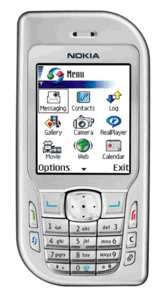
That is why I got myself a Nokia 6670. I did quite some research on it before the purchase, both online and offline, and my experience with it is simply excellent. It has all the basic features that I need and I am quite satisfied with it. I opted for the model because I didn't want to spend a lot of money on an object that I could lose easily, get stolen easily or let go and break even more easily. But I didn't want to end up with a stone-age cell phone either. And I think I have succeeded in timing my purchase just right so that I can get my next gadget (not 'phone', your next 'phone' may not be a 'phone'. Says who? Says Nokia!) My point: The price may stagnate at the current level, giving no incentive to wait any longer and your phone's life is just enough to take you to the next wave.
That is why I got myself a Nokia 6670. I did quite some research on it before the purchase, both online and offline, and my experience with it is simply excellent. It has all the basic features that I need and I am quite satisfied with it. I opted for the model because I didn't want to spend a lot of money on an object that I could lose easily, get stolen easily or let go and break even more easily. But I didn't want to end up with a stone-age cell phone either. And I think I have succeeded in timing my purchase just right so that I can get my next gadget (not 'phone', your next 'phone' may not be a 'phone'. Says who? Says Nokia!) My point: The price may stagnate at the current level, giving no incentive to wait any longer and your phone's life is just enough to take you to the next wave.
Apr 20, 2006
Quantum encryption - The new security frontier
What has Werner Heisenberg got to do with computer security? A lot, actually. Quantum encryption technology is maturing fast enough to replace the current encryption technologies employed in today's digital systems, and the best thing about this is that, it is theoretically unbreakable. The final frontier in security may not be too far.
We will go back to what Heisenberg has got to do with all of this. Werner Heisenberg, in 1927, discovered a very interesting property of elementary particles. Based on his experiments, he concluded that it was impossible to accurately measure the position and momentum of an elementary particle simultaneously. The key word is 'accurately'; you can predict either one accurately, but the other one would lend itself only with a degree of uncertainty. [Uncertainty principle]
Coming back to the normal world, current encryption technologies almost invariable use keys - public key encryption is the most preferred. However improbable breaking this security system may seem, with enough computing power on a parallel-processing system, it is possible to compromise the security by the classic "brute-force" attack.
Quantum encryption is immune to this because the photonic stream which carries the data is ruled by the Uncertianty principle and anyone trying to intercept the stream will alter the state of the photons in a way that it will be detected. Thus, in theory, it is impenetrable and can be proven mathematically.
Quantum encryption and NIST breakthrough
Apr 10, 2006
IBM joins the hardware encryption club
Let us face it. The world we live in is not a very secure one. You are not safe, nor is your precious data. Everyone, from multinational corporations to ordinary citizens doing their banking on the Net is paranoid when it comes to data security. And maybe it is this paranoia that is getting the big computer makers out there to build more and more hardware with built-in security. Soon after Intel's announcement of LaGrande technology that integrates encryption into the central processing functions, IBM is following suit with its SecureBlue system.
According to CNN, IBM researchers are of the opinion that as long as the CPU, essentially the brain of the computer and the encryption engine are two different systems, hackers can get in between the two and cause enough harm or steal whatever data he needs. Intel's implementation uses something known as a Trust Platform Module (TPM) and Apple's new Intel-based PCs are rumoured to carry these (Read more).
Hardware security, then again, is only as good as the chip designers have made it. Unlike software which can be upgraded for bug fixes or updated to include more features and tighter security, hardware implementation is something only the designers know about and is essentially a black box. If we believe that it is truly secure, our security is only as strong as that belief.
One interesting point noted in the article is the comment of Bruce Schneier, founder of Counterpane Internet Security Inc., on the new security system: "Security is a chain and it's as strong as its weakest link. They're talking about taking a very strong link and making it a little bit stronger, at best. Maybe."
Apr 8, 2006
DRM and hardware security
Did you just get a new Mac with an Intel chip inside or are you planning to get one soon? If so, you might find this article interesting.
I don't know a lot about how TPM (Trusted Platform Module) technology works, but if this article is even half right, you may think twice before getting that Mac.
The one thing in the article that caught my attention was the reference to the EFF's (Electronic Frontier Foundation) analysis of the Trusted Computing initiative, in which a significant portion of security implementations are based on hardware. (Read more about it here.)
It opens a very fundamental question - is hardware security really secure? Just consider the following hypothetical situations :
1. The hardware version has implementation errors - This is something very serious because it basically means you will have to throw out your whole hardware to ensure that it is secure. If the software had bugs or glitches, you can always replace it with an upgrade or a completely different system, much like changing the firmware of your cellphone. You would never even know this until you come up with something like what Intel faced with the Pentium FDIV bug. (And it wasn't pretty.)
2. The hardware vendor intentionally creates backdoors - This is an unlikely scenario, but far more dangerous than the previous one. While the former possibility would arise only when discovered by somebody accidentally and then find ways to misuse it, this option gives the vendor known pathways into the system. The possibilities of abuse are endless and I wouldn't even want to imagine what the vendor could do with such a kind of privilege.
I am no Mac expert and I wouldn't know RISC from CISC, but if the article is pointing to something really fishy, I would rather stay with my PC for now.
Subscribe to:
Posts (Atom)